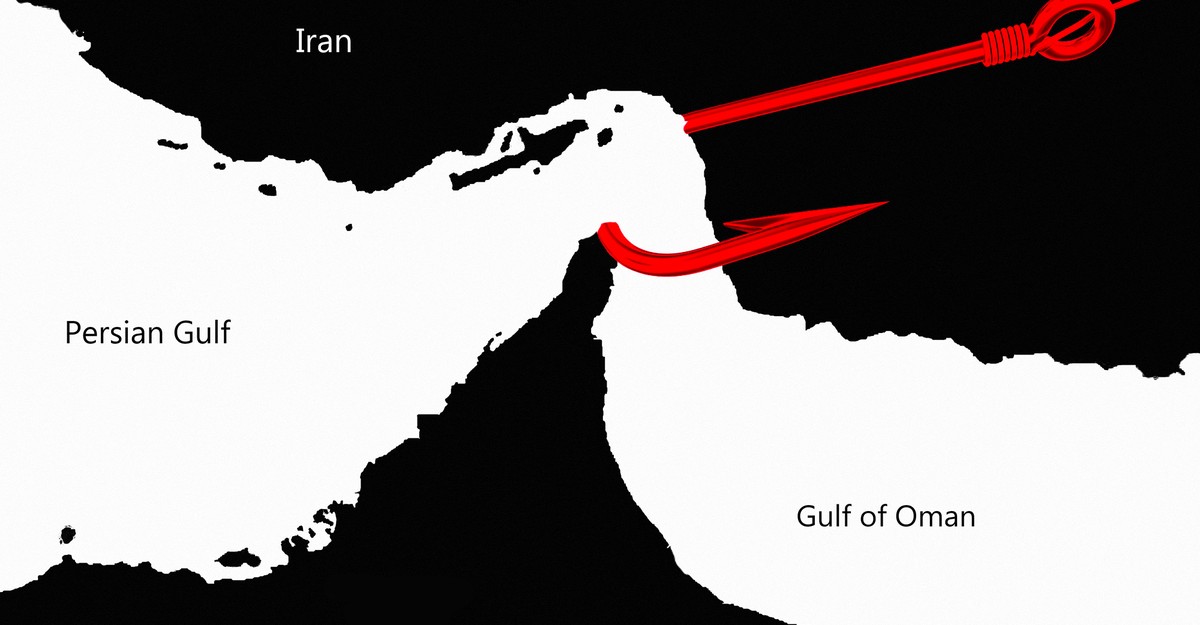
President Trump has said that he went to war to stop Iran from ever having a nuclear bomb. Unfortunately, the war he launched led Iran to discover that it already had an extremely effective doomsday weapon—one that promised the economic equivalent of mutual assured destruction. The Strait of Hormuz has always been vulnerable; the United States has always known that Iran might try to close it if attacked. But neither Washington nor Tehran imagined how easy it would be for Iran to do so, how hard it would be for the U.S. to reopen it, or how widely and rapidly the economic effects of a closed strait would fan out.
Fossil fuels are to modern industrial civilization what air is to the lungs: About 80 percent of the global economy is powered by oil, coal, and natural gas. Much of this comes from the states along the Persian Gulf: Saudi Arabia, Iraq, Iran, the United Arab Emirates, Kuwait, Qatar, Oman, and Bahrain. About 25 percent of global seaborne oil trade and 20 percent of global liquified natural gas transits the Strait of Hormuz, between the Persian Gulf and the Gulf of Oman.
Amos Hochstein: The Hormuz war will end
Iran has two navies—one that is part of its national armed services and one belonging to the Islamic Revolutionary Guard Corps—but it is not a maritime power. Its naval forces were quickly decimated once the American military operation began. General Dan Caine, the chairman of the Joint Chiefs of Staff, said at an April 8 briefing that the U.S. had sunk more than 90 percent of Iran’s regular fleet, leaving 150 ships at the bottom of the ocean along with half of the IRGC navy’s small attack boats.
Nonetheless, Iran closed the strait at the beginning of the American military campaign, and it wasn’t all that hard to do. Even without much naval capacity, Iran could threaten passing ships with mines, missiles, and cheap Shahed-136 drones. By attacking a few merchant ships and laying a few mines, it created an atmosphere of such pervasive insecurity that global marine-insurance markets, risk-averse by nature, either stopped providing coverage for transiting vessels or gave prohibitive rates.
So the strait turns out to be easy to close. It is also difficult to reopen—and, more important, to keep open. Even if the U.S. were to invest the time and resources needed for this task, the effort would likely yield far more body bags than Trump is willing to meet at Dover Air Force Base. Iran could well retaliate not just against U.S. forces, but also against vital energy infrastructure in the Persian Gulf countries. Naval convoys would be needed, which would require an international coalition, something Trump has proved uniquely unqualified to assemble.
The bitter reality is that getting maritime traffic through the strait back to the prewar level (about 130 vessels daily), and keeping it there, is essential to the global economy—and this can almost certainly not be done without Iran’s cooperation. The U.S. blockade of Iranian ports promises to inflict significant economic pain on Iran, but it doesn’t change this reality.
So why is Iran so keen on keeping the strait closed? The answer lies in strategic deterrence—the ability to prevent attacks on its homeland. Because its conventional military is underwhelming, the Islamic Republic has historically focused on asymmetric capabilities. The first pillar of Iran’s strategic deterrence was long understood to be its extensive armory of short- and medium-range missiles; the second was its proxy network, and the third was its advanced nuclear program, which gave it the capability to surge to nuclear-weapon-state status.
But events set in motion by Hamas’s October 7, 2023, terrorist attack on Israel—or, more precisely, Israel’s counterattack, culminating in the June 2025 12-day war with Iran—toppled these pillars. After that, Iran found itself largely defenseless and facing the threat of subsequent Israeli attacks should it seek to rebuild its deterrent potential. Once Operation Epic Fury began at the end of February, the Iranian regime, fighting for its life, sought a riskier, yet potentially more powerful form of deterrence: control of the Strait of Hormuz. Yes, shutting down traffic also hurts Iran, but the regime is gambling that it can endure more short-term pain than Trump can, especially in an election year.
In addition to weaponizing the strait, Iran is also seeking to monetize it, to generate funds for postwar reconstruction. Iran has announced a toll on all friendly ships passing through, payable in either cryptocurrency or Chinese yuan. Unfriendly ships (such as those belonging to the U.S. or Israel) will not be allowed to transit. Iran has claimed that such tolling is the new normal and will continue after the war is over, international law be damned.
The Gulf countries find such an arrangement unacceptable. It not only decreases their profits, but also requires them to give money to an enemy that just attacked them. Even China, which has significant influence over Iran, could wind up opposing the toll, because it depends heavily on commodities that pass through the strait. As for Trump, who knows? At one point he said that the U.S. could jointly administer a toll system with Iran. What matters most to him is that traffic through the waterway resumes as soon as possible, so as to minimize economic pain ahead of the November midterms.
But even if the strait were to fully reopen, months would likely pass before the economic damage would lessen and shipping flows would resume. On April 14, the International Monetary Fund warned that the extent of the economic shock from the closed strait, including inflation and reduced growth, “will depend on the conflict’s duration and scale—and how quickly energy production and shipment normalize once hostilities end.” The stoppage of oil and gas shipments is bad in itself; it also affects the flow of goods such as nitrogen fertilizer (essential for growing crops), sulfur, and helium (essential for the semiconductor and medical sectors).
Missy Ryan: Trump ditched hearts and minds in the Iran war
The history of war, the scholar Norman Ricklefs has noted, “is also the history of unintended consequences.” This war’s supposed proximate cause was Iran’s nuclear program. Trump conjured improbable images of Iranian nukes raining down on American cities. Then, like something out of Jorge Luis Borges’s Garden of Forking Paths, the conflict sent us all lurching in a new, darker, and more ominous direction.
Tehran might well modulate its grip on the strait as part of the negotiations. Indeed, today Foreign Minister Abbas Araghchi announced that the strait will be “completely open for commercial ships for the remainder of the ceasefire.” But Iran’s performance has fallen short of its pronouncements before. According to hard-line Iranian media, Iran is now routing traffic to a new transit lane through Iran’s territorial waters (formerly the route went through Omani waters). Using this passage will require coordination with the IRGC Navy.
Regardless of whether Iran allows maritime traffic to increase during negotiations, the reality is that Iran continues to “hold the key to the strait,” as the Iran expert Danny Citrinowicz, formerly of Israeli military intelligence, put it on X. Tehran may have relaxed its choke hold on this vital waterway, but the Islamic Republic, battered and seeking a way to stave off future aggression, is unlikely to release it for the foreseeable future.